

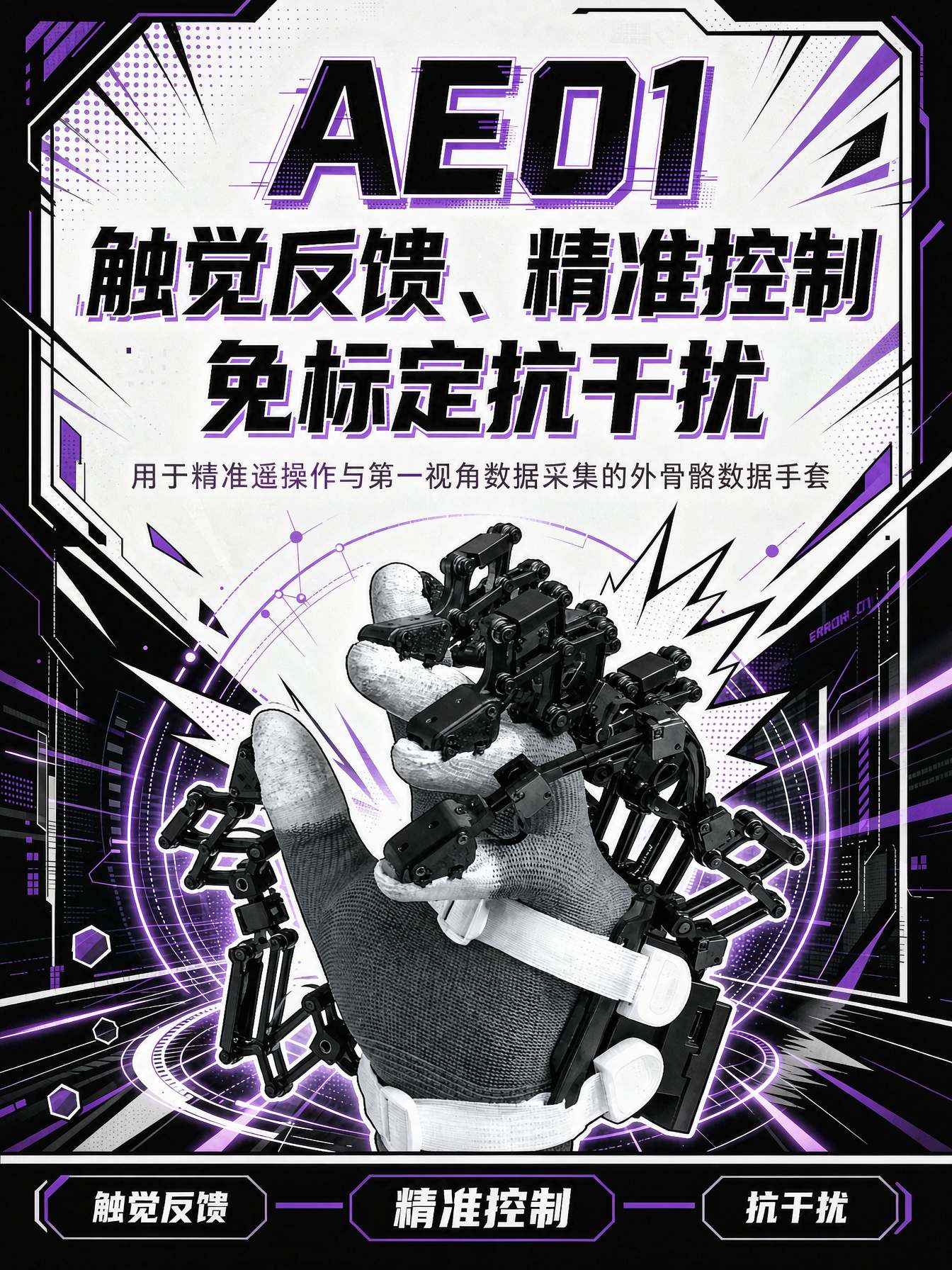
2026年,机器人“皮肤”的生意开始分叉。在刚刚结束的IROS 2026上,主打机器人触觉与灵巧操作的Sharpa同时发布D01机器人、W02灵巧手和AE01外骨骼数据手套。其中AE01用22个编码器记录操作者的手部关节运动,五个指尖各配一枚振动马达,把遥操作中的接触信息反馈给操作者。戴上它,操作者既能遥控机器人,也能采集第一视角示教数据。
In 2026, the robot "skin" business is bifurcating. At the recently concluded IROS 2026, Sharpa, which focuses on robot touch and dexterous manipulation, simultaneously released the D01 robot, W02 dexterous hand, and AE01 exoskeleton data glove. The AE01 uses 22 encoders to record the operator's hand joint movements, with a vibration motor in each of five fingertips, feeding contact information from teleoperation back to the operator. Wearing it, the operator can both remotely control the robot and collect first-person demonstration data.
戴盟也把触觉生意的链条摆到了台前:DM-Tac触觉传感器、Data-Nexus数据采集系统,以及触觉锚定世界模型Daimon-TWM。在IROS现场,戴盟演示了穿珠和帆布袋热转印。Sharpa把触觉产品从机器人端伸向数采工具,戴盟则把传感器、数采系统和模型摆到了一起。帕西尼还把包括触觉的具身数据摆进商城。机器人触觉厂商正在围绕“皮肤”争取进入四类预算:零部件、数采工具、数据和模型。但在这四类预算中,哪些能变成独立生意,哪些只是为了把硬件卖得更好,目前还没有清晰答案。
Daimler also put its tactile business chain on display: DM-Tac tactile sensors, the Data-Nexus data collection system, and the tactile-anchored world model Daimon-TWM. At IROS, Daimler demonstrated bead threading and canvas bag heat transfer printing. Sharpa extends tactile products from the robot end to data collection tools; Daimler puts sensors, data collection systems, and models together. PaXini even put embodied data including tactile information into its mall. Robot tactile manufacturers are competing around "skin" to enter four budget categories: components, data collection tools, data, and models. But among these four, which can become standalone businesses and which merely help sell more hardware, there is no clear answer yet.
机器人“皮肤”本身已经开始走量。今年2月,福莱新材与灵心巧手签下10万套触觉传感器订单。此前,双方已经完成1000套交付。从千套交付到10万套订单,触觉传感器开始从样品走向规模化制造。数采工具收的是另一笔钱,它要帮助研发团队把人的动作、机器人的画面和触觉信息记录到一起。9月,上海大学计划以22万元采购一套兼具视觉、触觉采集和模型训练功能的系统;吉林大学则以20万元购入一套由遥操作机械臂、相机和视触觉传感器组成的采集平台。两所高校买的不是单个传感器,而是一套用于生产机器人训练数据的工具。
Robot "skin" itself has started to scale. In February this year, Flexon New Materials signed a 100,000-unit tactile sensor order with Linker Hand. Previously, the two had completed 1,000-unit delivery. From thousand-unit delivery to a 100,000-unit order, tactile sensors are moving from samples to scaled manufacturing. Data collection tools collect another bill—they help R&D teams record human motion, robot imagery, and tactile information together. In September, Shanghai University planned to procure a system combining vision, tactile collection, and model training for 220,000 yuan; Jilin University purchased a collection platform consisting of a teleoperated robotic arm, camera, and visuotactile sensors for 200,000 yuan. What these two universities bought is not a single sensor, but a set of tools for producing robot training data.
相比已经出现10万套订单的触觉传感器,数采工具才刚开始按套卖给高校。第二张账单已经出现,但它能否进入企业的常规采购,还要看每小时能产出多少有效数据、部署一个新任务需要几天。设备卖出去以后,触觉厂商还想再开一张账单:采出来的数据,能不能脱离硬件继续卖。戴盟上线Daimon-Infinity,首批公开1000小时数据。除了视觉、动作和语言,数据里还包括指尖触觉的形变、剪切和深度信息。截至10月6日,魔搭页面的累计下载计数已经超过918万。
Compared with tactile sensors that already have a 100,000-unit order, data collection tools have just begun selling by the set to universities. The second bill has appeared, but whether it can enter enterprises' routine procurement depends on how much effective data can be produced per hour and how many days it takes to deploy a new task. After equipment is sold, tactile manufacturers want to open another bill: can the collected data be sold separately from the hardware? Daimler launched Daimon-Infinity, initially publishing 1,000 hours of data. Beyond vision, action, and language, the data also includes fingertip tactile deformation, shear, and depth information. As of October 6, the ModelScope page's cumulative download count has exceeded 9.18 million.
今年5月,卓世科技与戴盟签署战略合作框架协议。按照协议,卓世科技将使用戴盟的含触觉全模态数据训练模型,戴盟将提供1亿条模型训练数据。戴盟机器人合伙人兼首席商业官张栋表示,北美和中国的大厂都在购买戴盟的数据做验证。帕西尼走得更直接,它把包括触觉信息的全模态具身数据分成八类,摆进商城标价,页面可见任务的“单价”多为5元、7元和9元。但价格对应一条轨迹、一段视频还是一个数据包,页面没有解释;戴盟也没有披露客户金额和复购情况。
In May this year, Zhuoshi Technology signed a strategic cooperation framework agreement with Daimler. Under the agreement, Zhuoshi Technology will use Daimler's tactile-inclusive full-modality data to train models, and Daimler will provide 100 million model training data entries. Daimler Robotics partner and Chief Commercial Officer Zhang Dong said major companies in North America and China are buying Daimler's data for validation. PaXini is more direct: it divides full-modality embodied data including tactile information into eight categories, puts them in its mall with prices, and visible task "unit prices" are mostly 5, 7, and 9 yuan. But whether the price corresponds to one trajectory, one video, or one data package, the page does not explain; Daimler also has not disclosed customer amounts or repeat purchases.
有人需要数据,只是第一道门槛。数据能不能卖给第二位客户,才决定它更接近可复用的资产,还是一次项目交付。触觉数据偏偏很难过这一关。问题在于,第二位客户未必使用同一种传感器。视觉数据虽然也受镜头和光线影响,但至少共享像素这一表达形式。触觉信号却与传感器的材料、结构和标定方式绑在一起。硬件一换,模型接收到的可能已经不是同一种“触感”。在论文《TacVerse》中,研究人员用7种视触觉传感器采集10.68万张图像,测试同一个模型能不能跨传感器工作。一个用GelSightMarker数据训练的30类栅格分类模型,在原传感器上的准确率为90.3%。换到结构相近的GelSightNoMarker,准确率降至24.8%;换到差异更大的MagicGripper,只剩5.4%,已经接近3.3%的随机水平。
Someone needing data is only the first threshold. Whether data can be sold to a second customer determines whether it is closer to a reusable asset or a one-off project delivery. Tactile data struggles particularly with this. The problem is that the second customer may not use the same sensor. Visual data, though affected by lens and lighting, at least shares the pixel representation. Tactile signals, however, are tied to the sensor's material, structure, and calibration method. Change the hardware, and the model may no longer receive the same "touch." In the paper TacVerse, researchers used 7 visuotactile sensors to collect 106,800 images, testing whether the same model could work across sensors. A 30-class grid classification model trained on GelSightMarker data achieved 90.3% accuracy on the original sensor. Switched to the structurally similar GelSightNoMarker, accuracy dropped to 24.8%; switched to the more different MagicGripper, only 5.4% remained, close to the 3.3% random level.
论文还在另一项力回归任务中测试了少量目标传感器数据适配。模型表现虽有回升,仍未追平在同款传感器上训练和测试的结果。这就是触觉数据的“换肤成本”。数据能标价,不等于能够复用。如果第二位客户使用的是另一款“皮肤”,重新标定、转换和补采的成本就可能再次出现。这时,它仍然更像定制项目,而不是可以反复销售的商品。
The paper also tested a small amount of target sensor data adaptation in another force regression task. Model performance recovered somewhat but still did not match results from training and testing on the same sensor model. This is the "skin-change cost" of tactile data. Data can be priced, but that does not mean it can be reused. If the second customer uses a different "skin," the costs of recalibration, conversion, and supplementary collection may reappear. At that point, it still looks more like a custom project than a product that can be repeatedly sold.
触觉数据一旦跨传感器就难以直接复用,触觉厂商向模型延伸也就有了另一层意义:在行业标准尚未统一时,先让数据在自家的软硬件体系里发挥作用。戴盟发布的Daimon-TWM,被称为“触觉锚定世界模型”。它把触觉用于机器人的状态判断、动作推演和实时控制。以插接任务为例。摄像头看起来已经对准,指尖受力却可能显示插头正在顶歪。机器人需要停下来,抬起,再换一个角度,而不是沿着原来的轨迹继续向前推。在戴盟公布的测试中,Daimon-TWM在调整、擦拭、插入和装配四类任务上的平均成功率为64.0%,同一测试中的π0.5为26.0%。加入人为触碰和平台位置变化等扰动后,两者分别为53.5%和5.8%。
Once tactile data is hard to reuse directly across sensors, extending toward models gains another layer of meaning: before industry standards are unified, first let data function within one's own software and hardware system. Daimler's Daimon-TWM is called a "tactile-anchored world model." It uses touch for robot state judgment, action reasoning, and real-time control. Take insertion tasks. The camera looks aligned, but fingertip force may show the plug is being pushed crooked. The robot needs to stop, lift, and try another angle, rather than continuing forward along the original trajectory. In Daimler's published tests, Daimon-TWM achieved an average success rate of 64.0% across four task types—adjustment, wiping, insertion, and assembly—while π0.5 in the same test scored 26.0%. After adding disturbances such as human touch and platform position changes, the two scored 53.5% and 5.8% respectively.
这不是第三方测试,也不能把全部提升都算在触觉模型头上。但至少在戴盟设置的任务中,Daimon-TWM受到干扰后的成功率下降更少,表现出比π0.5更强的调整能力。商业上的问题随之改变。模型未必需要单独卖,也可以成为整套系统的一部分,帮助整套软硬件方案成交。对公司来说,两种方式都能创造价值;对投资人来说,它们却是两种完全不同的生意。前一种是可以独立定价、持续授权的软件收入。后一种只是全栈方案中的能力,最终仍要靠硬件和项目回款。Daimon-TWM已经展示出完成具体任务的能力。但从“能干活”走到“能收费”,还需要更多商业化证据。
This is not a third-party test, and not all improvement can be attributed to the tactile model. But at least in Daimler's configured tasks, Daimon-TWM's success rate drops less after disturbance, showing stronger adjustment capability than π0.5. The commercial question changes accordingly. The model does not necessarily need to be sold separately; it can also be part of a full system, helping the entire software-hardware solution close deals. For the company, both approaches create value; for investors, they are two completely different businesses. The former is software revenue that can be independently priced and continuously licensed. The latter is merely a capability within a full-stack solution, ultimately still relying on hardware and project payments. Daimon-TWM has demonstrated the ability to complete specific tasks. But moving from "can work" to "can charge" requires more commercialization evidence.
现阶段,机器人“皮肤”的产品链虽然变长,但越往数据和模型走,能够公开核对的交易证据越少。传感器和数采工具已经有订单或采购记录;数据端虽然出现了定价和购买验证,但交易金额与复购仍未披露;模型端则主要是产品发布和公司测试。因此,2026年更像是机器人“皮肤”从技术样品走向产品化的一年;数据和模型的价值已经显现,但尚未形成可以独立验证的收入模式。真正决定触觉厂商价值的,不是产品名单有多长,而是每向前走一层,能不能多拿到一笔独立预算。
At this stage, the robot "skin" product chain has lengthened, but the further toward data and models, the less publicly verifiable transaction evidence exists. Sensors and data collection tools already have orders or procurement records; on the data side, pricing and purchase validation have appeared, but transaction amounts and repeat purchases remain undisclosed; the model side is mainly product launches and company tests. Therefore, 2026 is more like the year robot "skin" moves from technical samples toward productization; the value of data and models has emerged, but an independently verifiable revenue model has not yet formed. What truly determines the value of tactile manufacturers is not how long the product list is, but whether each step forward can secure another independent budget.


