

2026年,具身智能产业站在了一个关键节点上。上半年,我国人形机器人出货量超过4万台,全球占比进一步提升至97%。工业和信息化部预计2026年全年人形机器人产量有望突破10万台。从制造端看,机器人造出来已不是问题,但从造出来到用起来,中间还有一道尚未完全打通的关口——数据。训练机器人,需要大量真实场景中的物理交互数据作为教材。据统计,目前全球可用的高质量真实数据仅为数十万至百万小时级,而机器人要迎来ChatGPT时刻,需要千万小时级的真实数据,供需之间存在量级差距。
In 2026, the embodied intelligence industry stands at a critical juncture. In the first half of the year, China's humanoid robot shipments exceeded 40,000 units, with global share further rising to 97%. The Ministry of Industry and Information Technology expects full-year 2026 humanoid robot output to potentially exceed 100,000 units. From the manufacturing side, robots being "built" is no longer a problem, but from "built" to "used," there remains a barrier not yet fully cleared—data. Training robots requires large amounts of physical interaction data from real scenarios as "textbooks." According to statistics, globally available high-quality real data is only in the hundreds of thousands to million hours range, while for robots to reach their "ChatGPT moment," tens of millions of hours of real data are needed—an order-of-magnitude gap between supply and demand.
如何推动人形机器人跨过数据关?具身智能训练场成了关键。最初,训练场因数据需求而建,随技术演进,训练场正从单纯的数据生产走向场景化的实景实训,成为真实物理环境中集数据生产、模型训练与能力验证于一体的关键基础设施,就像机器人的学校。日前,记者参加新型工业化调研行主题采访活动时来到国内首个基于真实场景的具身智能训练场——北京人形机器人创新中心具身智能机器人数据与训练基地,了解机器人如何在这里学干活。在基地近6000平方米的实训空间里,家居、快递分拣、化学实验等场景分区铺开,数十种构型、上百台机器人在不同操作台前反复练习。
How to push humanoid robots past the data barrier? Embodied intelligence training grounds have become key. Initially built for data needs, training grounds are evolving from pure data production toward scenario-based real-world training, becoming key infrastructure integrating data production, model training, and capability validation in real physical environments—like schools for robots. Recently, reporters joined the "New Industrialization Research Tour" themed interview activity and visited China's first real-scenario-based embodied intelligence training ground—the Beijing Humanoid Robot Innovation Center's Embodied Intelligence Robot Data and Training Base—to learn how robots "learn to work" here. In the base's nearly 6,000-square-meter training space, scenarios including home, express sorting, and chemistry experiments are laid out in zones, with dozens of configurations and over a hundred robots repeatedly practicing at different workstations.
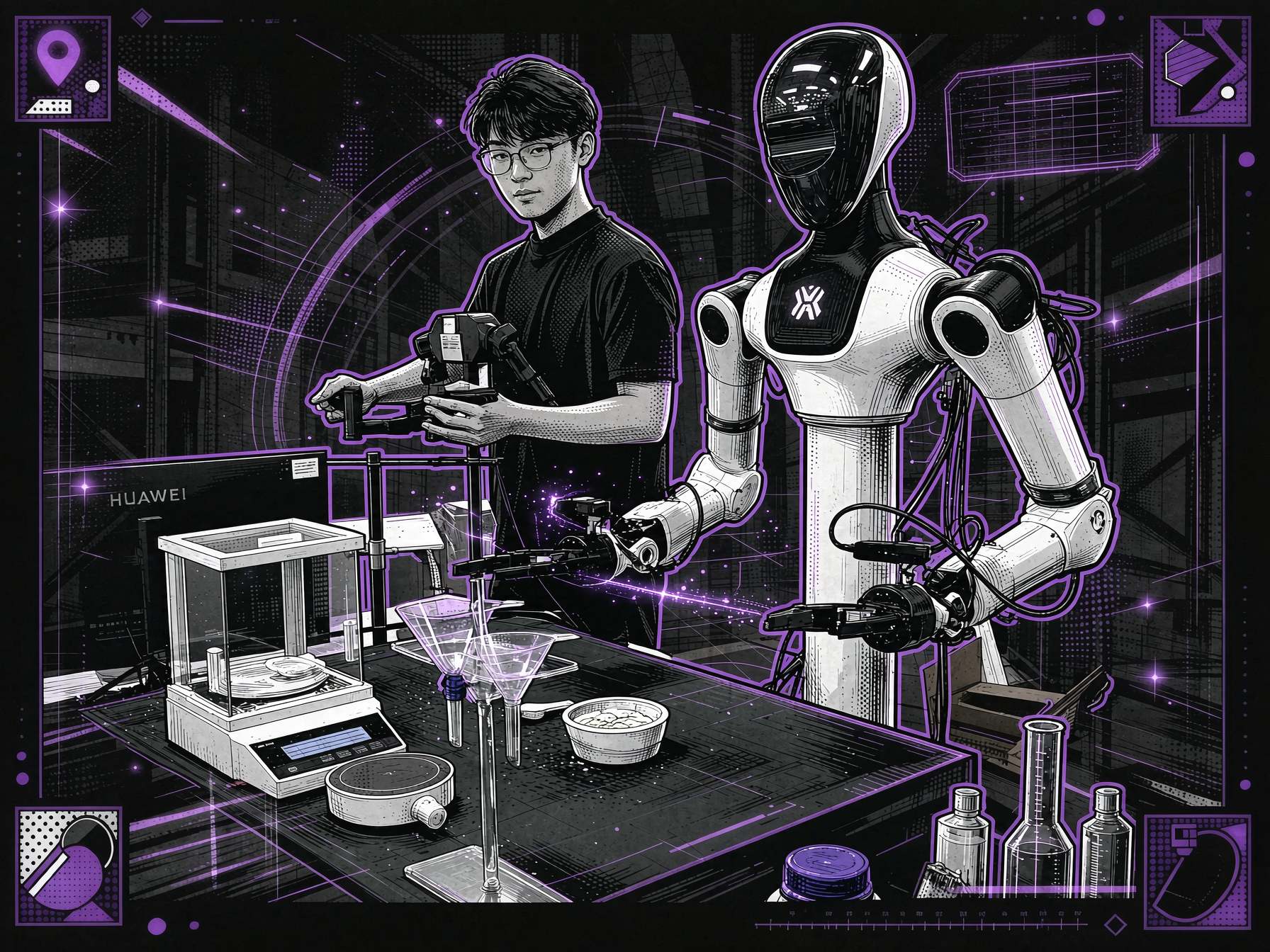
化学实验场景中,一款人形机器人正学习如何夹取托盘,并控制设备,称量固定克重粉末。这是一个精细化操作的实训场景,对机器人动作的精度要求很高。机器人身旁的数据采集员穿戴采集设备,小心翼翼地进行夹取物品、称量粉末等操作,机器人有样学样,一旁的电脑屏幕上,运动轨迹数据滚动更新,实时回传到数采系统中。北京人形数据与训练基地项目经理刘磊介绍,这些动作看着很简单,但要想让机器人像人一样熟练,需要大量真实数据训练模型。数据采集员的每一次操作,都是在目标物体的形状、颜色、数量、位置等多种因素随机组合、动态变化场景中反复采集演示数据。通过学习,机器人不光会模仿,还可以逐步掌握适应不同环境的能力。
In the chemistry experiment scenario, a humanoid robot is learning how to grip a tray and control equipment to weigh a fixed gram weight of powder. This is a fine manipulation training scenario with high precision requirements for robot movements. Beside the robot, a data collector wears collection equipment, carefully performing operations like gripping items and weighing powder. The robot imitates, and on a nearby computer screen, motion trajectory data scrolls and updates in real time, transmitted back to the data collection system. Liu Lei, project manager at the Beijing Humanoid Data and Training Base, explained that these movements look simple, but for robots to become as proficient as humans, large amounts of real data are needed to train models. Every data collector operation repeatedly collects demonstration data in scenarios where target objects' shape, color, quantity, and position randomly combine and dynamically change. Through learning, robots not only imitate but gradually master the ability to adapt to different environments.
截至2026年6月,全国已建成启用超70家具身智能训练场,在建、规划40余家。但具身智能产业发展面临的坎,不光是数据少,还有高质量数据少。北京人形数据与训练基地产品负责人史明威坦言,现在市面上很多训练场对外宣称有多少万小时、亿小时的数据,但实际上可用的是从中抽离出的高质量数据。对行业来说,1万小时的高质量数据,可能比100万小时的重复数据更重要,因为很多数据其实是质量不合格或机器人用不起来的。什么样的数据才称得上高质量?刘磊以居家整理场景为例说:高质量数据就是机器人到了这个场景后,能自动判定哪些物品需要整理,哪些物品在摆放的过程中易碎需要小心谨慎操作。反过来,如果在操作过程中对目标判定是模糊、犹豫的,这种情况就是低质量数据。
As of June 2026, over 70 embodied intelligence training grounds have been built and put into use nationwide, with over 40 under construction or planned. But the hurdle facing embodied intelligence industry development is not just scarce data, but scarce high-quality data. Shi Mingwei, product head at the Beijing Humanoid Data and Training Base, admitted that many training grounds on the market claim "how many tens of thousands or hundreds of millions of hours of data," but what is actually usable is the high-quality data extracted from it. For the industry, 10,000 hours of high-quality data may be more important than 1 million hours of duplicate data, because much data is actually unqualified or unusable by robots. What kind of data qualifies as "high quality"? Liu Lei used a home organizing scenario as an example: high-quality data means that when the robot arrives at this scenario, it can automatically determine which items need organizing, which items are fragile and require careful handling during placement. Conversely, if the operation process shows vague or hesitant judgment of targets, that is low-quality data.
高质量的定义,要根据模型的训练结果去验证得出来。刘磊介绍,目前基地已搭建典型机器人实训场景30余个。2025年12月,北京人形机器人创新中心面向全球开发者开源开放具身智能数据集RoboMIND,目前全球下载量已突破2000万次。为提高数据生产的质量,基地构建了一条完整的数据闭环链路。海量数据采集后,会自动上传至数采系统后台,经过清洗、标注、校验、质检等环节,最终留下的有效、高质量数据将被用于算法模型的迭代训练。这些数据既服务自身机器人研发,也向外部客户提供。在上述链路中,质检、标注等环节并非全靠人工。史明威告诉记者,他们会先利用AI进行自动化处理,之后再由人工做少量的质检和标注。
The definition of "high quality" must be validated based on model training results. Liu Lei introduced that the base has now built over 30 typical robot training scenarios. In December 2025, the Beijing Humanoid Robot Innovation Center open-sourced the embodied intelligence dataset RoboMIND to global developers, with global downloads now exceeding 20 million. To improve data production quality, the base has built a complete data closed-loop chain. After massive data collection, it automatically uploads to the data collection system backend, going through cleaning, labeling, verification, and quality inspection, with the final effective, high-quality data used for iterative algorithm model training. This data serves both its own robot R&D and external customers. In this chain, quality inspection and labeling are not entirely manual. Shi Mingwei told reporters they first use AI for automated processing, then manual workers do少量 quality inspection and labeling.
实际上,闭环的关键在于数据加工完成之后。史明威提到,成品数据交付给模型团队,经测试验证后进行真机部署,正常来说一个闭环就结束了。但实际上我们更关注这个模型部署到真机后,在实际作业中遇到哪些问题。我们会通过自动化手段,把问题回流到数采系统中进行分析,并针对性地再次进行数据采集,这就形成了一个大的闭环。当前,人形机器人在快递分拣、工业制造等场景已经有了应用,但不少具身智能训练场依然保留着上述场景。对此,刘磊以快递分拣为例解释说,分拣过程中的关键指标是效率和质量,现在快件种类还不够全面,如有软包裹、硬包裹、生鲜蔬菜、异常外观包裹等,需要大规模数据补充。
In fact, the key to the closed loop lies after data processing is complete. Shi Mingwei mentioned that finished data is delivered to the model team, tested and validated, then deployed on real machines—normally a closed loop ends there. "But we actually care more about what problems this model encounters in actual operations after deployment to real machines. We use automated means to flow problems back to the data collection system for analysis, and conduct targeted data collection again—this forms a larger closed loop." Currently, humanoid robots already have applications in express sorting, industrial manufacturing, and other scenarios, but many embodied intelligence training grounds still retain these scenarios. Liu Lei explained using express sorting as an example: key metrics in sorting are efficiency and quality, but current package types are not comprehensive enough—soft packages, hard packages, fresh produce, abnormally shaped packages—all require large-scale data supplementation.
地图类产品每年需要测试员驾车收集城市信息,因为城市会更新变化,机器人模型也要持续补充认知识别能力。刘磊强调,具身智能赛道所有的数据都需要持续补充,不是说到了某一个节点就足够用了,可能机器人这一生都不够用。如果每换一种机器人构型、每换一个场景,就要重新采集一遍数据,生产成本高,具身智能用起来的链条也难以持续。为此,北京人形数据与训练基地采用了多种方法,提高数据跨场景、跨本体复用的泛化性。一方面,在指定场景下不过多限制采集任务和动作;另一方面,利用AI做模型泛化。同时,基地也会用头环等无本体设备让人来采,还会基于仿真数据进行模型训练,以保证数据的体量和模型面对不同形态的能力。现实生产生活也是数据的重要来源。
"Map products need testers driving to collect city information every year because cities update and change; robot models also need continuous supplementation of cognition and recognition capabilities." Liu Lei emphasized that all data in the embodied intelligence track needs continuous supplementation—it is not that at some point it becomes sufficient; "possibly a robot's entire life is not enough." If every robot configuration change or scenario change requires re-collecting data, production costs are high, and the chain for embodied intelligence to be "used" is hard to sustain. To this end, the Beijing Humanoid Data and Training Base uses multiple methods to improve data generalization for cross-scenario and cross-body reuse. On one hand, it does not overly restrict collection tasks and actions in specified scenarios; on the other, it uses AI for model generalization. The base also uses bodyless devices like headbands for humans to collect data, and trains models based on simulation data to ensure data volume and the model's ability to face different forms. Real production and life are also important data sources.
史明威说,靠人力安排任务的方式,只能解决少量问题,要想实现真正的泛化,还得把机器部署到真实场景中去,做整个数据闭环。据了解,北京人形数据与训练基地年数据产能可达18万小时,已对外交付近3万小时高质量数据。该基地将上百套无本体采集设备送到家庭、工业等真实环境,让数据采集从样板间走向真实产线。目前,这个基地正朝着产出百万小时级高价值、高可用、可论证的人形机器人交互数据迈进。工业和信息化部数据显示,2025年,我国人工智能核心产业规模超过1.2万亿元,企业超过6200家。
Shi Mingwei said relying on manpower to arrange tasks can only solve a small number of problems. To achieve true generalization, machines must be deployed into real scenarios to do the entire data closed loop. It is understood that the Beijing Humanoid Data and Training Base has annual data capacity of 180,000 hours and has delivered nearly 30,000 hours of high-quality data externally. The base sends over a hundred sets of bodyless collection devices to real environments like homes and industry, moving data collection from "model rooms" to real production lines. Currently, this base is advancing toward producing million-hour-level "high-value, high-availability, verifiable" humanoid robot interaction data. MIIT data shows that in 2025, China's AI core industry scale exceeded 1.2 trillion yuan, with over 6,200 enterprises.
中国信息通信研究院近期发布的《具身智能训练场研究报告(2026年)》指出,近两年,具身智能训练场迅速在全国掀起建设热潮,但场景任务建设同质化、数据实际产能有限、数据多样性和流通性不足以及可持续商业模式尚未形成等问题逐渐凸显。有关部门已关注到数据供给问题。记者从国家发展改革委了解到,下一步,将以具身智能实训场和应用中试基地为抓手统筹布局具身智能实训场,加强数据、模型、标准等要素供给。在数据方面,将构建高质量真机数据采集系统,提升具身智能数据供给质量与规模,破解具身智能训练数据饥渴问题。
The China Academy of Information and Communications Technology's recently released "Embodied Intelligence Training Ground Research Report (2026)" points out that in the past two years, embodied intelligence training grounds have rapidly set off a construction boom nationwide, but problems including homogenized scenario task construction, limited actual data capacity, insufficient data diversity and circulation, and no sustainable business model yet formed are gradually emerging. Relevant departments have noticed the data supply problem. Reporters learned from the National Development and Reform Commission that next, it will use embodied intelligence training grounds and application pilot bases as handles to coordinate the layout of embodied intelligence training grounds and strengthen supply of data, models, standards, and other factors. On data, it will build a high-quality real-machine data collection system, improve the quality and scale of embodied intelligence data supply, and solve the "data hunger" problem in embodied intelligence training.


