

刚刚过去的国庆假期,机器人密集进入景区上岗。在北京颐和园、敦煌鸣沙山、厦门鼓浪屿,机器人开始深度嵌入景区的日常运营,除了负责表演互动,还负责了零售消费、智能导引和智能巡检等任务。据不完全统计,目前已有几十家具身智能及机器人企业进入文旅、零售和消费服务场景,国庆期间仅人形、轮式人形及具身操作机器人在这些场景的在岗规模已达数千台。而在这股浪潮中,珠海横琴长隆飞船乐园与智元机器人的合作,是迄今为止规模最大的样本。2026年9月24日,横琴长隆飞船乐园迎来300台机器人,在100余个交互体验点正式“上岗”。
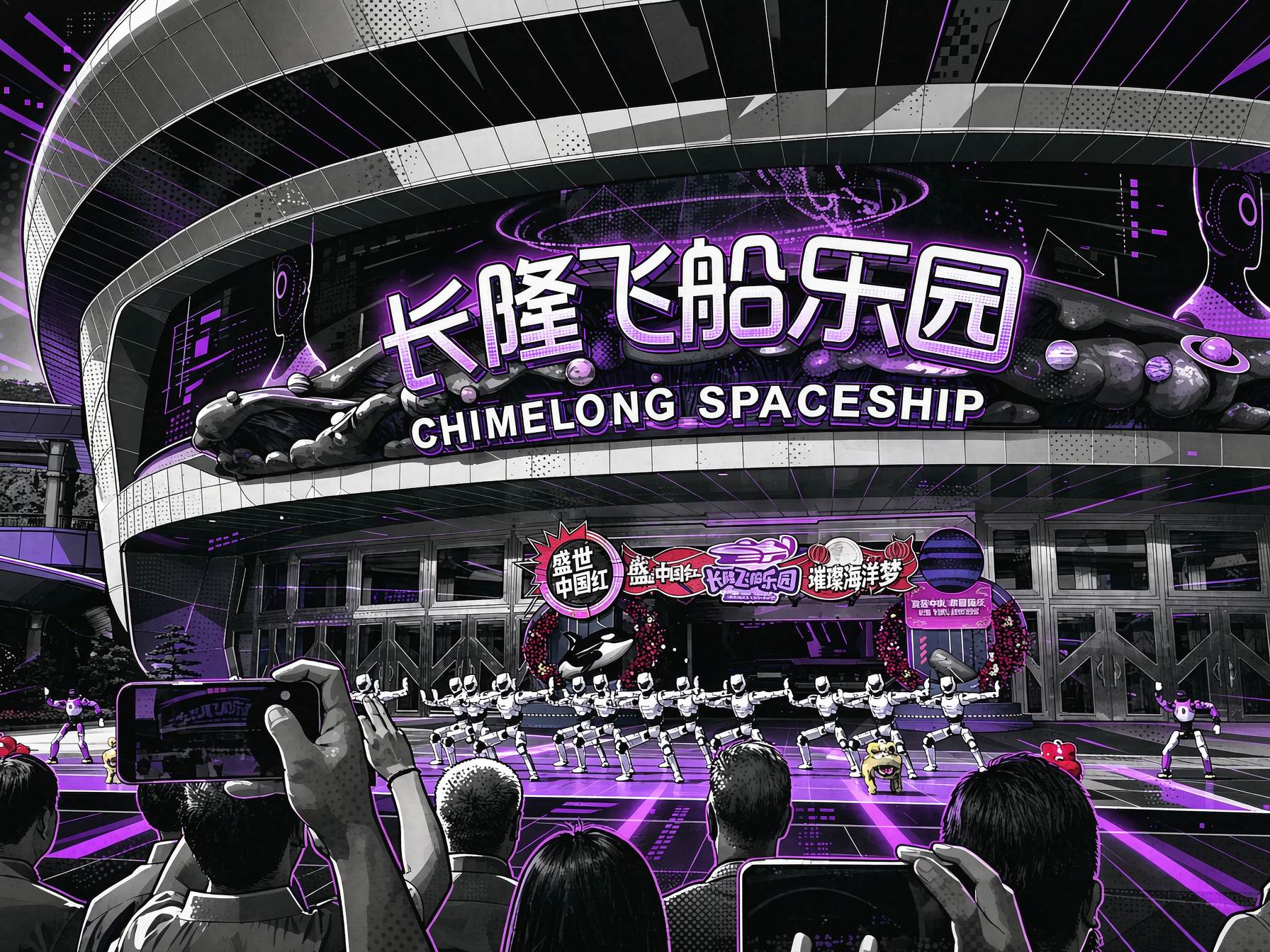
During the just-concluded National Day holiday, robots密集 entered scenic areas for duty. At Beijing's Summer Palace, Dunhuang's Mingsha Mountain, and Xiamen's Gulangyu, robots began deeply embedding into scenic areas' daily operations, handling not only performances and interactions but also retail consumption, intelligent guidance, and intelligent inspection. According to incomplete statistics, dozens of embodied intelligence and robotics companies have entered cultural tourism, retail, and consumer service scenarios. During the National Day holiday, the on-duty scale of humanoid, wheeled humanoid, and embodied manipulation robots in these scenarios reached thousands. In this wave, the cooperation between Zhuhai Hengqin Chimelong Spaceship Park and AgiBot is the largest sample to date. On September 24, 2026, Chimelong Spaceship Park welcomed 300 robots, officially "reporting for duty" at over 100 interactive experience points.
在长隆飞船乐园,机器人不再只是定点表演的展品,它们覆盖了文娱商演、科普研学、导览导购导引、服务零售、智能伴游、酒店服务、体育竞技七大场景。游客也可以和机器人猜拳、打乒乓球、下三子棋,听机器人讲解海洋知识,在零售点咨询商品。从规划到开园,300台机器人的上工,只用了1个月的时间。这一速度在具身智能的落地历史上是罕见的。传统模式下,机器人从实验室走向真实场景往往需要数年的打磨与验证。智元合伙人、联席总裁熊彦回应称,要让机器人在常态化部署的情况下去接受考验。他表示,选择9月24日开园,是因为中秋、国庆双节相连,是全年的客流高峰期,双方愿意一起挑战这件很难的事。
At Chimelong Spaceship Park, robots are no longer just fixed-point performance exhibits—they cover seven major scenarios: entertainment performances, science education, guided tours and shopping, service retail, intelligent companionship, hotel services, and sports competition. Visitors can play rock-paper-scissors, table tennis, and three-in-a-row with robots, listen to robots explain ocean knowledge, and consult about products at retail points. From planning to opening, 300 robots went to work in only 1 month. This speed is rare in embodied intelligence deployment history. Traditionally, robots moving from laboratory to real scenarios often require years of refinement and validation. AgiBot partner and co-president Xiong Yan responded that robots must be tested under normalized deployment. He said September 24 was chosen because the Mid-Autumn and National Day holidays are connected, the peak visitor season of the year, and both parties were willing to tackle this difficult thing together.
乐园是开放环境,充满动态任务。火热部署的另一面,是真实运营中不断暴露的体验短板。目前相对集中的问题,是高环境噪声、高密度点位的语音交互与网络稳定性。熊彦描述了一个典型场景:场馆广播、背景音乐、几十个人同时说话,孩子随时跑过来插一句,还有各种口音和谐音,机器人要先在嘈杂声场里听清谁在跟我说话,再听懂说的是什么,还要判断该不该接话,任何一环出错,游客体验就断了。这类问题不影响安全,但影响体验,是当前调试优化的重点。
The park is an open environment full of dynamic tasks. The other side of hot deployment is experience shortcomings constantly exposed in real operations. Currently, problems are relatively concentrated in voice interaction and network stability under high environmental noise and high-density points. Xiong Yan described a typical scenario: venue broadcasts, background music, dozens of people talking at once, children running over to interject, and various accents and homophones. The robot must first hear clearly who is talking to me in the noisy sound field, then understand what is being said, and also judge whether to respond. Any link failing breaks the visitor experience. Such problems do not affect safety but affect experience, and are the current focus of debugging and optimization.
有游客在社交媒体平台上表示,飞船乐园宣传是具身智能机器人主题乐园,也有机器人嘉年华,但是每个机器人边上都配上了1到2位人类工作人员,帮助保障机器人的安全运行。一位曾经体验过游乐园项目的游客告诉《中国新闻周刊》,以写毛笔字的机器人为例,机器人不会蘸毛笔,要工作人员蘸了墨水后才能开始写。“字写得挺好看,但是等工作人员蘸墨水,就要排队很久,游客就不耐烦了。”熊彦提道:“运营到目前为止不是零故障。开园以来的真实常态是:整体运行平稳、未发生大的安全事故,同时各类小问题和体验改进每天都在发生。”他表示,每天要处理上百条反馈。
Some visitors said on social media that Spaceship Park advertised itself as an embodied intelligence robot theme park and robot carnival, but each robot had 1 to 2 human staff beside it to help ensure safe operation. A visitor who had experienced a park project told China Newsweek that, taking the calligraphy robot as an example, the robot cannot dip the brush itself—staff must dip ink before it can start writing. "The characters are quite nice, but waiting for staff to dip ink means queuing for a long time, and visitors get impatient." Xiong Yan said: "Operations so far are not 'zero failure.' The real norm since opening is: overall stable operation, no major safety incidents, while various small problems and experience improvements happen every day." He said he handles over a hundred feedback items daily.
熊彦将工厂产线与乐园场景做了对比:产线交付是把一件事做对一万次,乐园交付是一万个不确定的人随机发起互动,每一次都要接得住。长隆项目中,一个值得注意的现象是,简单但互动性强的项目反而比技术难度更高的功能更受欢迎。熊彦透露,猜拳、拼豆子、下三子棋、打乒乓球等很受游客欢迎,这些能力相对成熟。而拳击赛起初只有两台机器人对打,没有配乐和解说,点位偏冷;后来配上音乐、加入专业解说,趣味性提升,如今已成超热门项目,上台机器人从两台调整到六到八台。这意味着游客为体验和情绪买单,而不是为技术难度本身买单。
Xiong Yan compared factory production lines with park scenarios: production line delivery is "doing one thing right ten thousand times"; park delivery is "ten thousand uncertain people randomly initiating interactions, and every one must be caught." In the Chimelong project, one notable phenomenon is that simple but highly interactive projects are more popular than technically harder functions. Xiong Yan revealed that rock-paper-scissors, bead拼, three-in-a-row, and table tennis are very popular with visitors—these capabilities are relatively mature. The boxing match initially had only two robots fighting, without music or commentary, at a cold point; later with music and professional commentary, fun increased, and now it has become a super popular project, with robots on stage increased from two to six to eight. This means visitors pay for experience and emotion, not for technical difficulty itself.
当下,乐园的运维压力不小。在乐园高强度连续运行下,机器要面对散热、电量、设备轮值这些运维课题。目前运维人员与机器人的配比是1:3,原因是双节高峰叠加开园初期,智元投入了较多研发和运维保障人员。300台机器人,意味着还有约100名工作人员在旁协助。这还没算上运维、技术驻场等隐性人力。一名运维人员的一天大致是:每天早上8点半到位,9点开始和园区一起检查,领先客流半小时以上完成各点位准备。开园后持续巡场处置问题,协助长隆运营人员进行机器人操作,记录和分析互动体验中的问题。下午闭园后,运维人员会和长隆一起开夕会、每天复盘,当晚要完成各点位的体验改进和验收。
Currently, park operations pressure is considerable. Under high-intensity continuous park operation, machines face heat dissipation, battery, and equipment rotation challenges. The current operations staff to robot ratio is 1:3, because the double-holiday peak叠加 opening初期, AgiBot invested more R&D and operations support personnel. 300 robots means about 100 staff assisting nearby. This does not count hidden manpower like operations and technical on-site support. A operations person's day roughly: arrive at 8:30 a.m., start inspections with the park at 9, complete point preparations over half an hour ahead of visitor flow. After opening, continuously patrol and handle problems, assist Chimelong operations staff with robot operation, record and analyze interaction experience problems. After afternoon closing, operations staff hold evening meetings with Chimelong, daily debriefs, and must complete experience improvements and acceptance at each point that night.
熊彦表示,近期优化目标是运维人员与机器人配比1:10,理想目标是1:20。运维的压力往往靠人力的协调可以解决。但更为艰巨和长期的难题是攻克数据。行业高质量物理交互数据仍然严重稀缺。野村证券研报估算全行业高质量物理交互数据需求约1000万小时,现有存量仅约50万小时。中国工程院院士陈学东也明确指出,数据荒是最大卡点,互联网数据无法替代真实物理互动数据,现实采集成本极高。机器人数据难题对景区应用的影响,核心在于从实验室到真实场景的最后一公里无法靠仿真跨越。熊彦也提到,机器人要真正做到像人一样无须调试、适应各种环境,还需要3到5年。
Xiong Yan said the near-term optimization goal is a 1:10 operations staff to robot ratio, with an ideal goal of 1:20. Operations pressure can often be solved by manpower coordination. But the more arduous and long-term challenge is cracking data. Industry high-quality physical interaction data remains severely scarce. A Nomura research report estimates industry-wide demand for high-quality physical interaction data at about 10 million hours, with existing stock at only about 500,000 hours. Chinese Academy of Engineering academician Chen Xuedong also pointed out that the "data shortage" is the biggest bottleneck; internet data cannot replace real physical interaction data, and real-world collection costs are extremely high. The impact of robot data challenges on scenic area applications centers on the last mile from laboratory to real scenarios that cannot be crossed by simulation. Xiong Yan also mentioned that for robots to truly operate without debugging and adapt to various environments like humans, another 3 to 5 years are needed.
先于长隆一个月开园的韩国首尔“星系机器人公园”,是目前国际范围内与长隆项目在时间节点和业态形态上最为接近的案例。该项目由韩国娱乐科技公司Galaxy Corporation运营,占地约5000坪(约1.65万平方米),位于首尔江东区。Galaxy Corporation CEO崔龙湖对媒体透露:公司原本预计需求有限,原本打算免费提供演出,结果实际开始卖票后,一天能有多达1000名观众进场。在他们看来,游客愿意为机器人表演的娱乐内容买单。Galaxy Corporation的野心远不止一个首尔园区。CEO明确表示,计划2026年底在迪拜开设机器人公园2号店,2027年上半年进入纽约,同时筹备机器人偶像的全球巡演。
Seoul's "Galaxy Robot Park," which opened one month before Chimelong, is currently the case internationally closest to the Chimelong project in timing and business format. The project is operated by South Korean entertainment technology company Galaxy Corporation, covering about 5,000 pyeong (about 16,500 square meters) in Seoul's Gangdong District. Galaxy Corporation CEO Choi Yong-ho told media that the company originally expected limited demand and planned to offer performances for free, but after actually starting ticket sales, up to 1,000 visitors entered per day. In their view, visitors are willing to pay for "entertainment content performed by robots." Galaxy Corporation's ambitions extend far beyond one Seoul park. The CEO explicitly stated plans to open Robot Park Store No. 2 in Dubai by the end of 2026, enter New York in the first half of 2027, and simultaneously prepare a global tour of robot idols.
中国主题公园研究院院长林焕杰表示,机器人作为新生事物确实能引发好奇、带来话题和客流,有些游客好奇就去了。但他同时强调,这种引流伴成本也在显著增加。在他看来,机器人引流是一种可用的短期手段,绝非低成本甚至可持续的解决方案。
Lin Huanjie, dean of the China Theme Park Research Institute, said robots as a new thing can indeed spark curiosity, generate话题, and bring visitor flow—some visitors go out of curiosity. But he also emphasized that this traffic-driving comes with significantly increasing costs. In his view, robot traffic-driving is a usable short-term tool, definitely not a low-cost or even sustainable solution.


